
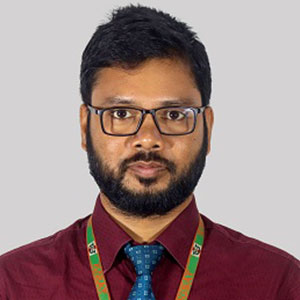
Dr Nayem Hossain
Associate Professor
PhD (DUET), M.Sc (DUET)
BSME (IUBAT)
Email: nayem.hossain@iubat.edu
Room# NARP RESEARCH LAB, Ext# 148
Dr. Nayem Hossain is an Associate Professor of Mechanical Engineering at International University of Business Agriculture and Technology (IUBAT). He completed both his Master’s and PhD degrees at Dhaka University of Engineering & Technology (DUET), where he built a strong foundation in advanced materials and engineering research. Throughout his academic career, he has remained committed to advancing scientific knowledge, promoting research excellence, and mentoring the next generation of researchers.
Dr. Hossain’s research encompasses a broad range of interdisciplinary fields, including materials science, nanotechnology, corrosion engineering, tribology, advanced composites, additive manufacturing, biomedical materials, and sustainable engineering. His work focuses on developing innovative solutions to complex engineering challenges while contributing to the advancement of both fundamental and applied research. Through extensive collaborations and continuous scholarly engagement, he has established a strong international research presence.
His scientific contributions have been published in numerous peer-reviewed international journals and have received more than 7,000 citations worldwide, demonstrating the global reach and impact of his research. In recognition of his scholarly influence, Dr. Hossain has been included among the Stanford University–Elsevier World’s Top 2% Scientists for consecutive years. This prestigious distinction recognizes researchers whose work has achieved exceptional impact within their respective scientific disciplines.
In recognition of his outstanding research productivity and scholarly impact, Dr. Hossain has received multiple distinctions from the Miyan Research Institute at IUBAT. He was ranked as the university’s Top Researcher in both 2024 and 2025 through the annual Miyan Publication Reward Program, which evaluates scholarly contributions published in SCIE, SSCI, Scopus-indexed, and other high-impact journals. Among faculty members across diverse academic disciplines, he achieved the highest research ranking based on the quality and influence of his scientific publications.